

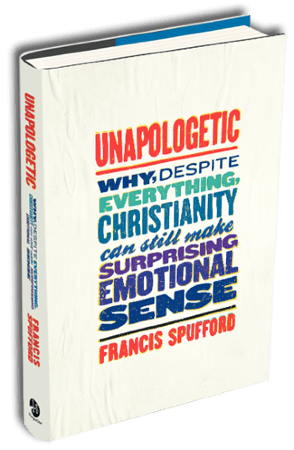
In his most recent book, Unapologetic: Why, Despite Everything, Christianity Can Still Make Emotional Sense, English author (and Anglican Christian) Francis Spufford gives voice to the way that sin and guilt have made him feel, which is exactly the way it makes me feel. And no one, certainly not Jason Micheli or Herbert McCabe or Thomas Aquinas, can convince me that I feel this way without justification—and that from God’s perspective, everything is A-OK. I know everything is not A-OK about me. And the fact that it isn’t matters to God. And by God’s grace he’s working to change me. And it hurts sometimes. And I’m glad it hurts because, like good old Bactine, that’s how you know it’s healing you.
For someone like Micheli to pat me on the head and say, “The way you make yourself right with God is to recognize that things are already right,” is no comfort at all. It doesn’t ring true to my experience.
And I’m obviously not alone in feeling this way.
Regardless, I’ll quote the relevant passage from Spufford. He later includes enlightening illustrations about the lives of penitent slave-trader and “Amazing Grace” author John Newton and British Field Marshal Montgomery. Spufford’s message is that guilt is a good, necessary, and inescapable fact of human existence. It’s not an overreaction on our part: we ought to feel guilty, even as we avail ourselves of the resources of Christian faith that enable us to live with it. (Note: Like it or not, Spufford uses profanity in his book, and in the following excerpt. What we might call “original sin,” he calls the “Human Propensity to F— Things Up,” which he abbreviates as HPtFtU in his book.)
He precedes this quote by talking about the recent popularity of serial killers on TV, in movies, and in novels. These stories appeal to us because they place evil safely outside of ourselves.
But HPtFtU is in here, not out there. The bad news is bad news about us, not just about other people. And when the conviction of it settles in, when we reach one of those states of our lives where the sorrow of our failure hangs in our chests like a weight, and waking up in the morning is painful because every time the memory of what’s wrong has to ooze back over the lovely blankness of the night—you’ll know what I mean if you’ve ever been there—then, the idea that it would help to cling to a cozy sense of victimhood seems as silly as it would be to try and fight off the flu by waving a toy lightsaber. The bad news, at those moments, feels like the whole truth about you. It isn’t. It is only a truth about you. But the way back to the rediscovery of the rest of what’s true begins with the admission that you really are guilty of the particular bit of HPtFtU which is making you feel like shit. If you don’t give the weight in your chest its true name you can’t even begin. It’s guilt that drags at your steps, it’s guilt that paints the morning black. In my experience, in times of intense misery it’s letting your guilt be guilt that at least stops you needing to accuse yourself; and in better times, in times of more or less cheerful ordinary muddling through, I’ve found that admitting theres’s some black in the color-chart of my psyche doesn’t invite the blot of dark to swell, or give a partial truth more gloomy power over me than it should have, but the opposite. Admitting there’s some black in the mixture makes it matter less. It makes it easier to pay attention to the mixedness of the rest. It helps you stop wasting your time on denial, and therefore helps you stop ricocheting between unrealistic self-praise and unrealistic self-blame. It helps you be kind to yourself.[†]
† Francis Spufford, Unapologetic: Why, Despite Everything, Christianity Can Still Make Emotional Sense (New York: HarperOne, 2013), 34-5.